

Payments routing is an area where a little effort can go a long way, but it’s also easy to miss out on a lot of efficiencies. Adding a second PSP and setting up failover rules is a solid first step. It’s better than relying on a single provider, but most routing setups stop there. This leaves a significant amount of acceptance rate improvements and cost reductions unrealized.
This overall guide focuses on efficiently routing payments across multiple PSPs. Before digging into the details, there are some baseline topics to cover in this chapter. If you’re already comfortable with the problem space, the challenges, and the constraints, you might be able to skip this chapter. But even if you’re familiar with these topics, there could be some useful bits of information.
There’s no single PSP that always has:
Transactions aren’t uniform and how PSPs handle them isn’t either. This creates performance variance across PSPs, but also within each PSP.
The variance comes from PSPs having different acquiring footprints, card scheme integrations, risk modeling, etc. It’s their entire system, including downstream partners, that evaluates transactions, processes them, and then charges for services rendered. You can take the same transaction and run it through different PSPs and have widely different results. It’s like dropping a disc into a giant Plinko board.
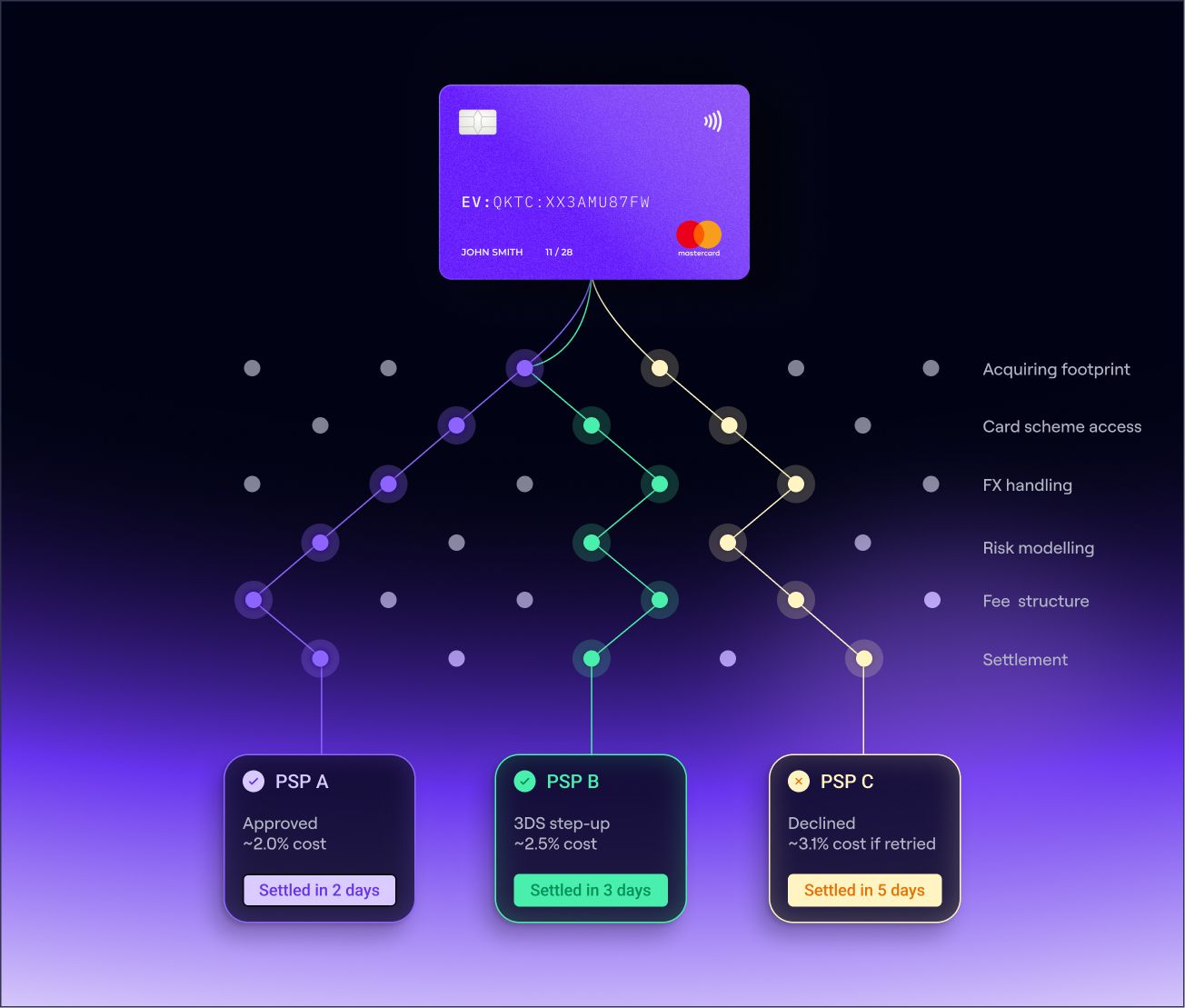
Variance goes a level deeper and exists at the individual PSP level too. If you snapshotted a transaction and ran it through a PSP today, and then again a month from now, the result could be different. PSP’s usually have their own risk modeling and base their routing and processing decisions on them. Those models have constant feedback mechanisms built into them so they’re always monitoring and adjusting. A transaction at the beginning of the month could be fine, but if a business has a lot of chargebacks during that month, the same transaction might fail or require 3D Secure or some other kind of verification.
Routing payments across multiple PSPs is about reducing variance and optimizing revenue. It also adds operational redundancy so you aren’t relying on a single PSP.
You can largely organize online transaction fees into three buckets.
| Fee | Paid to | What it covers | Estimated share of total fees paid |
|---|---|---|---|
| Interchange | Cardholder's bank (issuer), set by Visa, Mastercard, etc. and not negotiable. | Credit risk, fraud risk, rewards (points, cashback, etc.). | ~70–90% |
| Scheme / network fees | Visa, Mastercard, Amex, etc. | Network rails for routing, authorization, etc. Includes assessment fees (BPS on volume), cross-border fees, and network access and processing fees. | ~5–15% |
| PSP / acquirer fees | Payment processor / acquirer (e.g., Stripe, Adyen, Checkout.com). | Gateway and processing, risk and fraud tooling, reporting, APIs, support, and PSP margin. | ~5–20% |
This structure is commonly referred to as IC++. PSP fees, which generally cover the cost of the gateway, fraud tooling, reporting, and the processor's margin, are the only part of the fee stack you can actually negotiate. But those fees are also the smallest lever. The bigger driver of total cost is whether your PSP has local acquiring in the markets you sell to. Many PSPs also hold acquiring licenses, meaning they're the processor and the acquirer, but not all of them have local acquiring in every country. That distinction directly affects what you pay in interchange and scheme fees, which make up the bulk of your costs and vary based on several factors.
Acquiring has some of the biggest impacts on variance and it’s one of the most important things to consider when evaluating PSPs. Although somewhat simplified, you can think of acquiring on a spectrum from in-country (domestic) to in-region to cross-border.
Starting with in-country, the “distance” between the BIN (the bank identification number that identifies the issuer) and the acquirer is “shorter” because they’re in the same country. As you branch out, the gap becomes wider and the greater the distance, the more both costs and acceptance rates deteriorate.
| In-country | In-region | Cross-border |
|---|---|---|
| Example: card issuer and acquirer are in Malaysia | Example: card issuer is in Singapore and the acquirer is in Malaysia | Example: issuer is in the US and the acquirer is Malaysia |
| Low interchange fees | Medium interchange fees | High interchange fees |
| Low scheme fees | Medium scheme fees | High scheme fees |
| High issuer trust | Medium issuer trust | Low issuer trust, often requiring more verification steps like 3DS |
| High acceptance rates | Medium acceptance rates | Low acceptance rates |
There are a few reasons there’s such a difference with cross-border transactions.
Some PSPs have massive reach and can process payments in dozens of countries and numerous currencies. This is often when the world “global” enters the conversation which is a little problematic. Two PSPs might be able to process GBP (£) payments, but if one PSP has a local acquirer and the other doesn’t, the cost of that transaction can be very different.
Let’s look at an example to better illustrate the differences. The fees and percentages won’t be completely valid but they’re close enough to show the impact. Here’s the scenario: a US-based merchant is selling to a UK consumer. The transaction is £100 on a UK-issued Visa consumer credit card. We’ll compare two routing paths.
| Costs | Local | Cross-border |
|---|---|---|
| Interchange (paid to the issuer) | ~0.30% | ~1.50% |
| Scheme fees (paid to Visa) | ~0.11% | ~0.60% |
| PSP fee | ~0.20% + £0.10 | ~0.30% + £0.15 |
| TOTAL | ~£0.71 | ~£2.55 |
The cross-border route is over three times as costly as the local acquiring path. On this single transaction, that’s a ~£1.84 difference. That might not seem like a lot, but at scale, it’s business altering. On 10,000 transactions each at £100, that’s:
And that example doesn’t take acceptance rates into consideration. There would be a percentage of those 10,000 transactions that would fail with the cross-border acquirer but succeed with a local one. Even just a few percent difference would make a meaningful impact on revenue.
Beyond their acquiring footprint, there are some other structural factors that influence costs on the PSP side.
Something else we’ve seen sneak up on businesses are the internal processing thresholds that each PSP has. A PSP that performs well when you’re processing £50k/month can behave differently at £500k/month or £5M/month, even if nothing fundamentally changes about your business.
These thresholds are often based on each PSP’s own risk models and financial exposure, as well as regulatory and compliance obligations. There’s a broad range of triggers and associated actions when you hit these thresholds, but here are some examples.
These thresholds can be difficult to plan for and respond to. They vary by PSP and information about them is often spread across documentation, support articles, and contracts. Many businesses start out with a single PSP, and if they hit a threshold that can’t be resolved quickly, they might not see payouts for weeks or months.
Routing is a multi-dimensional problem. At the transaction level, performance depends on the card issuer, BIN, country, card type, and more. On top of that, issuer behavior, PSP performance, and card network conditions are constantly shifting.
Making it harder still is how most payment stacks are built. Teams typically start with a single PSP and add more over time, without a clear routing architecture in place from the start. This makes observability difficult. Collecting performance data across multiple PSPs, fraud tools, and other downstream partners is rarely straightforward, and without that data, it's hard to make informed routing decisions. The result is a problem that's multi-faceted, partially observable, and that needs to be solved in real time.
We’ll highlight specific examples but the main issue is routing at too broad a level. You need to be able to route based on granular information in real time.
| Routing | Issues |
|---|---|
| Single path ("PSP A handles everything, PSP B is a backup") | All traffic follows the same path regardless of transaction characteristics. PSP B only exists as a safety net. |
| Static rules ("PSP A for EU, PSP B for US") | Assumes performance is stable, ignores issuer-level differences, and doesn't adapt (or does so slowly). |
Some teams stop when they’ve implemented a second PSP for failover, or have a few PSPs and some static rules. These can be a good start, but they largely address resilience, with some slight optimization. Routing at this level doesn’t account for variance, and it doesn’t use segmentation at a deep enough level.
Segmentation is how you achieve the granularity that broad routing approaches miss. It means grouping transactions by shared characteristics (issuer, BIN, card type, acquirer, geography etc.), so you can analyze and route each group on its own terms, rather than optimizing for an average that may not accurately reflect individual transactions.
Without segmentation, routing decisions are based on blended performance numbers. This creates two problems: you miss optimization opportunities that only become visible at a granular level, and issues can hide in aggregate data, showing up as a symptom rather than a cause.
There are a ton of ways to segment transactions but the issuer, BIN, acquirer, and whether the card is debit or credit are the most impactful. This hopefully makes sense at a conceptual level, but let’s look at an example.
Let’s say you have customers in 25 countries and you notice an 8% drop in global acceptance rates. This isn’t good but it’s also not that helpful. You have access to BIN and geo-based information about your transactions though. So you look closer at which transactions are failing. You see a massive drop in acceptance rates for Brazilian issuers. Across other issuers, numbers are essentially the same. You’ve now identified the real problem and can start working out the solution.
That's what segmentation enables. Broad numbers highlight symptoms. Segmentation helps you find the cause.
Let’s take a closer look at routing based on:
PSP performance varies across many dimensions but these four segments offer some predictability. They can help you determine ahead of time which PSP is the best one to route a transaction to.
This is one of the most granular levels to route on but it’s also one of the most challenging. Issuing banks have different fraud models, risk tolerances, and 3DS step-up thresholds. They also have different relationships with acquirers and card networks. This means that one issuer might:
While another issuer might:
This means that the same transaction, routed through the same PSP, can have a different outcome depending on the issuer.
| Impact summary | Difficulty summary |
|---|---|
| Potentially very high (sometimes the best segment to optimize) | Requires mapping issuer behavior over time |
| Can unlock meaningful acceptance rate uplifts | Data can be noisy at low volumes |
| Operationally complex to maintain rules at this level |
The BIN is the first 6-8 digits of a card number and it’s what makes issuer-level routing practical at scale. It identifies the issuing bank, the card's country of origin, and the card type (debit, credit, commercial, etc.) in a single data point.
Issuers tend to operate consistently across their BIN ranges, which means patterns observed at the BIN level are usually a good reflection of issuer-level behavior. For example, you might observe one BIN range that performs better on cross-border transactions than others.
| Impact summary | Difficulty summary |
|---|---|
| High (often a practical, high-impact strategy) | Requires sufficient volume per BIN to detect patterns |
| More stable than issuer-level in many cases | Needs ongoing maintenance as BIN tables evolve |
| Still non-trivial, but more scalable than issuer-level |
We covered this in some detail already. You’d basically route through a local acquirer when possible and use a cross-border acquirer as a fallback.
| Impact summary | Difficulty summary |
|---|---|
| Very high (sometimes the biggest single lever) | Relatively low compared to issuer or BIN routing |
| Simultaneously improves cost and conversion | Mostly depends on having PSPs with the right coverage |
This is the broadest level we’ll cover. Debit and credit cards behave differently because:
For example, debit cards might have lower tolerance for cross-border or high-ticket transactions, and credit cards might perform better with certain PSP optimizations like retries or 3DS.
| Impact summary | Difficult summary |
|---|---|
| Moderate | Low (easy to identify and segment) |
| Often useful as a secondary optimization layer |
This is where your routing strategy starts to take shape. It takes the high level goal of “low costs, high acceptance rates” and applies it to every segment. In doing that, you have several tradeoffs and decisions to consider.
Routing payments is a constant balance between things like:
Not all transactions are equally valuable. As an example, let’s say you’re a digital game publisher and you run online stores for each of your titles. Games use different monetization strategies, so you’d have a variety of digital goods at different prices: microtransactions for in-game resources and currencies, high cost items like game pre-orders, and subscriptions for live games.
For microtransactions, because profit margins are small, you might route transactions to whatever PSP has the lowest cost to maximize profit. For higher priced items, where your profit margin is larger, you might route transactions to whatever PSP has the highest conversion rate and acceptance probability, even if processing costs are high. On the subscription side, you’d want to optimize for the overall lifecycle of the card on file. This would mean optimizing for successful retries and keeping card details fresh.
This chapter was about providing some necessary context: why routing payments matters, the challenges, and where approaches fall short. It established that payments routing is a multifaceted challenge that requires a dynamic solution. The next chapter introduces something we’ll call the routing system. We’ll cover the core components, what they do, and why they’re important.
This content is for general information and educational purposes only. It shouldn't be taken as legal, compliance, or tax advice. Evervault doesn't guarantee the completeness or accuracy of this content, and you should always consult with a lawyer, qualified security assessor (QSA), accountant, or similar professional for advice on any of the topics covered.